
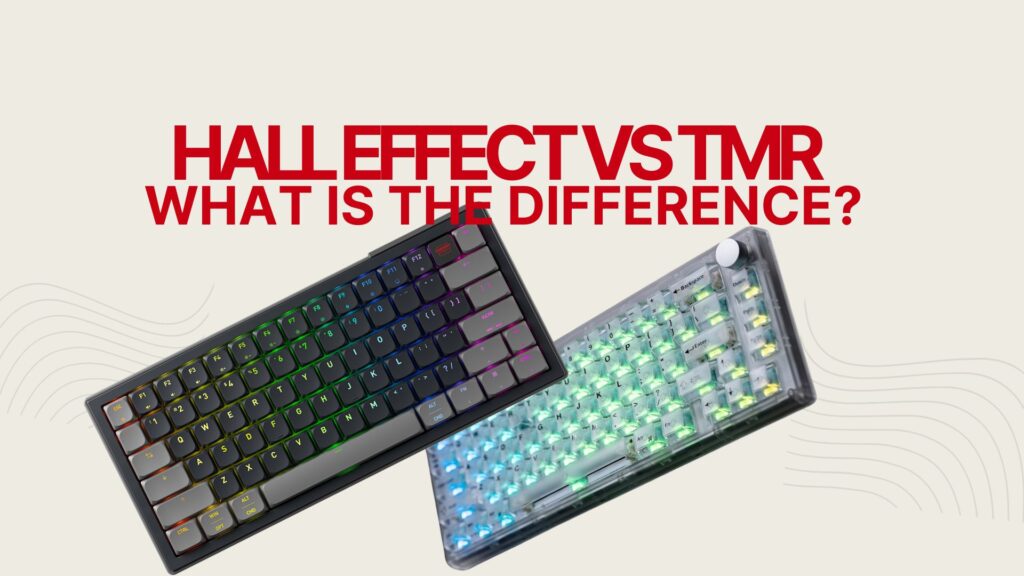
If you have been shopping for a gaming keyboard in 2026, you have seen two acronyms everywhere: Hall Effect (HE) and Tunneling Magnetoresistance (TMR).
- TMR vs Hall Effect: Head-to-Head Comparison
- What Is a Hall Effect Keyboard?
- What Is a TMR Keyboard?
- What Actually Changed in 2026?
- Precision and Multi-Axis Sensing: TMR’s Strongest Advantage
- Latency: Measurable But Small
- Power Consumption: TMR Wins
- Durability and Switch Compatibility
- Which Should You Buy?
- Frequently Asked Questions
Hall Effect (HE) keyboards have dominated the magnetic switch conversation since the Wooting 60HE popularized Rapid Trigger in 2022. But in 2026, a second magnetic sensing technology called TMR (Tunnel Magnetoresistance) is entering the mainstream, appearing in keyboards from Epomaker, CHERRY XTRFY, Akko, and Gamakay.
The common framing pits Hall Effect as the old standard and TMR as the new replacement. The reality is more nuanced. Keychron’s magnetic keyboards have used TMR sensors since the very first Q1 HE. And Wooting has explicitly pushed back on the narrative that HE is being replaced. Both technologies are mature in different ways, and the 2026 story is about TMR becoming widely available, not being invented.
This article compares both technologies across eight data points: detection method, multi-axis versus single-axis sensing, precision, latency, power consumption, durability, switch compatibility, and cost. We also include hands-on notes from testing the Epomaker HE65 V2 against the Wooting 80HE to give you real-world context rather than just spec sheet numbers.
TMR vs Hall Effect: Head-to-Head Comparison
Here is the data comparison across the key metrics that matter for a keyboard buyer.
| Feature | Hall Effect | TMR |
| Detection Method | Magnetic field strength | Magnetic tunnel junction resistance |
| Sensing Axes | Single-axis (linear) | Multi-axis |
| Min Actuation Step | 0.1 mm | 0.01 mm |
| Power Draw | ~5-10 mA per sensor | ~1-2 mA + amplification circuit |
| Temperature Drift | Moderate | Minimal |
| Input Latency | Low (1-2 ms typical) | Lower (~0.1 ms claimed, manufacturer spec) |
| Sensor Lifespan | 100M+ presses | 100M+ presses |
| Switch Compatibility | HE switches only | HE switches (backward compatible) |
| Market Availability | Wide (2023+) | Expanding (2026) |
| Price Premium | Moderate | Moderate to higher |
Latency caveat: The 0.1 ms figure for the HE65 V2 comes from Epomaker published specifications. We have not independently verified this with oscilloscope testing. What we can confirm from blind side-by-side use is that both the HE65 V2 TMR and the Wooting 80HE feel instant to the user.
More Read

What Is a Hall Effect Keyboard?
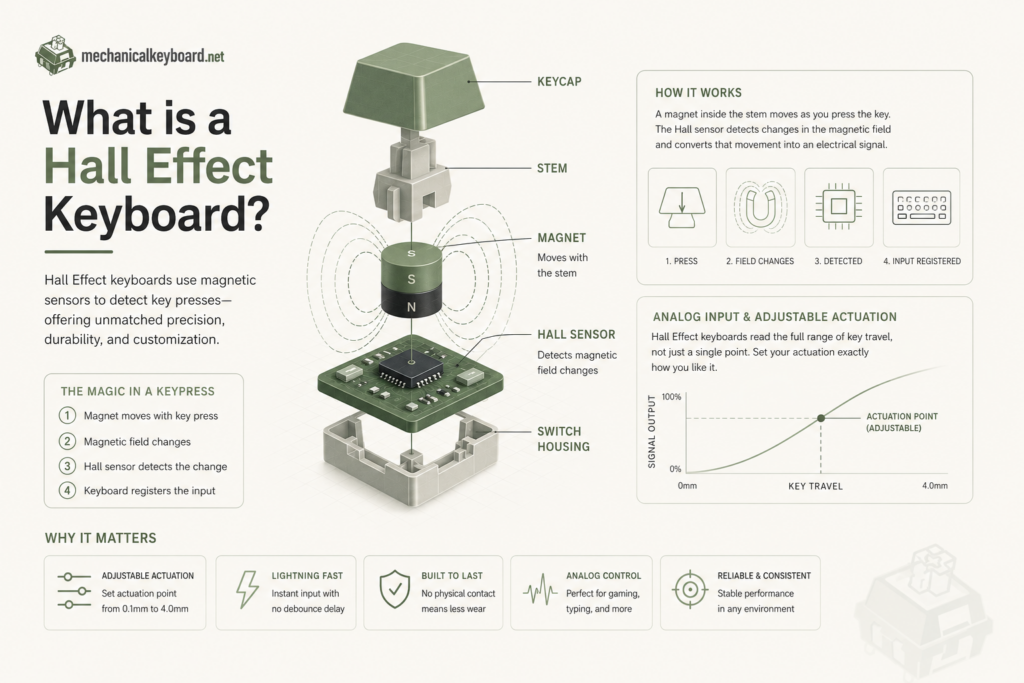
A Hall Effect keyboard uses magnetic sensors to detect key presses without physical contact. Inside each switch, a magnet moves past a Hall Effect sensor on the PCB. The sensor measures the magnetic field strength, and when the field crosses a threshold, the keyboard registers a key press.
This contactless design is the core advantage over traditional mechanical switches. There are no metal leaves to wear down, no debounce delay to filter out, and no electrical noise from physical contact. The result is a switch that can last over 100 million presses and supports features like adjustable actuation and Rapid Trigger.
The Wooting 60HE (2022) is widely credited with bringing Hall Effect keyboards to the gaming mainstream, though HE technology itself dates back decades in industrial sensing. Since 2022, every major brand has launched an HE lineup, including Keychron, Razer, Corsair, Epomaker, and NuPhy. The 60 percent form factor remains the most popular for competitive gaming, though TKL and 75 percent layouts are also widely available in HE variants.
What Is a TMR Keyboard?
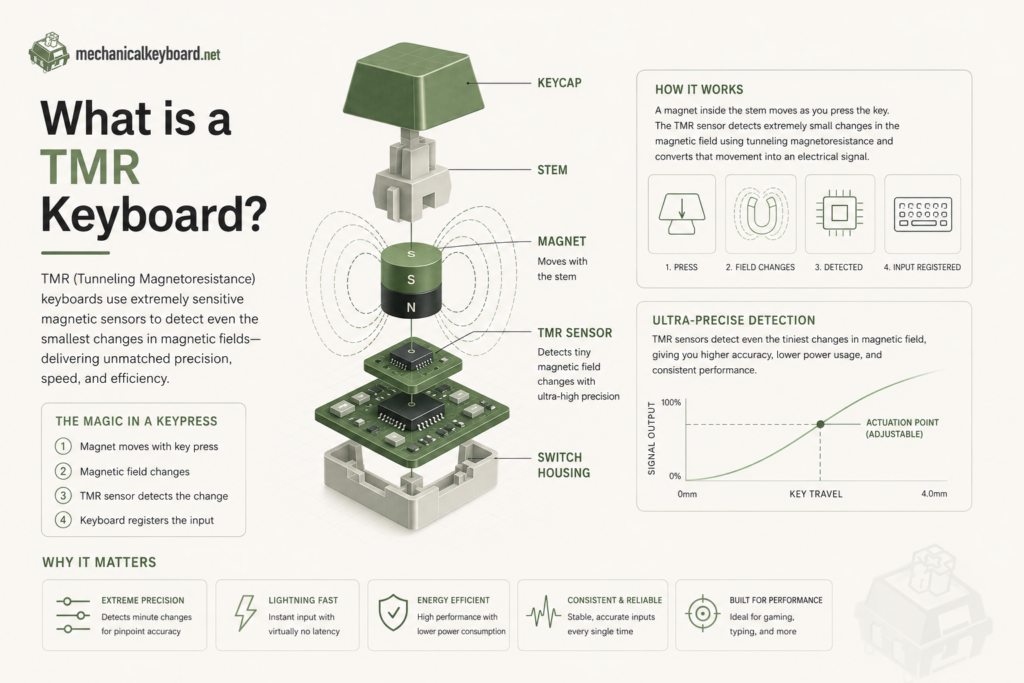
TMR stands for Tunnel Magnetoresistance. It is a magnetic sensing technology that detects key position by measuring the change in electrical resistance across a magnetic tunnel junction. The resistance shifts depending on the relative orientation of two magnetic layers: one fixed and one that moves with the switch stem.
Where a Hall Effect sensor measures how strong the magnetic field is, a TMR sensor measures how the resistance changes as the magnet moves. This difference creates real-world advantages: higher sensitivity (0.01 mm actuation steps), multi-axis sensing, lower power consumption at the sensor level, and better temperature stability.
What Actually Changed in 2026?
TMR sensors have existed in industrial applications for over a decade. Keychron used them in the Q1 HE as early as 2024. So why is 2026 the year TMR became a story? Three things changed.
1. Manufacturing costs dropped – TMR sensor chips were historically more expensive to produce. By late 2025, several Asian foundries ramped TMR sensor production, bringing per-unit costs down by an estimated 40-60 percent. This made TMR viable for keyboards at mainstream price points.
2. Brands needed a differentiator – By early 2026, the HE market was crowded. Every brand had an HE lineup. TMR gave brands a genuine hardware difference to market, especially multi-axis sensing which HE physically cannot replicate.
3. Wireless became a priority – Battery life is the weak link for wireless HE keyboards. TMR’s lower baseline power draw made it the natural answer, assuming the amplification circuitry is well engineered.
These three forces converged in early 2026. The result is that multiple TMR models are now available or announced, and the technology is expected to appear across most major brands’ lineups by early 2027.
Precision and Multi-Axis Sensing: TMR’s Strongest Advantage
The headline advantage of TMR is precision. Hall Effect sensors are limited by the physics of measuring a magnetic field’s absolute strength. Most HE keyboards offer actuation adjustments in 0.1 mm increments.
TMR offers two precision advantages that Hall Effect cannot match. First, multi-axis sensing means a TMR keyboard can detect not just how far a key is pressed, but whether it is pressed at an angle. Second, the resistance-based detection allows actuation steps as fine as 0.01 mm – a tenfold improvement.
For most users, 0.1 mm is more than enough. But for competitive FPS players who want micro-adjustments to their Rapid Trigger or Snap Tap behavior, the extra granularity can make a real difference.
Latency: Measurable But Small
Both technologies operate in the microsecond range for raw detection. TMR’s higher resolution position data allows faster firmware decisions about key actuation. In practice the difference is small. A well-tuned Hall Effect board like the Wooting 80HE already delivers latency well below human perception.
Both technologies support Rapid Trigger, Snap Tap, and Adjustable Actuation.
Power Consumption: TMR Wins
Hall Effect sensors draw roughly 5 to 10 mA per sensor. TMR draws 1 to 2 mA at the raw level, but requires additional amplification circuitry. Wooting’s testing found TMR consumed 5 to 10 times less power than Hall Effect after signal boosting. For wireless keyboards, TMR delivers roughly 2x better battery life.
Durability and Switch Compatibility
Both are contactless and rated for 100M+ presses. TMR is backward compatible with standard HE switches – you can move your existing HE switches to a TMR board. Standard MX keycaps also fit both.
Which Should You Buy?
Buy Hall Effect now if: you need a keyboard today, play competitive FPS with proven Rapid Trigger, want the widest selection and price points, or are on a budget.
Buy or wait for TMR if: you want the best actuation precision and multi-axis sensing, need wireless with the best battery life, or already own HE switches to repurpose.
For 95 percent of users, a good Hall Effect keyboard purchased today will serve you well for years. TMR matters most for wireless users and competitive players pushing HE to its limits.
Frequently Asked Questions
Q: What does HE stand for in keyboards?
A: HE stands for Hall Effect. An ‘HE keyboard’ uses magnetic Hall Effect sensors instead of physical metal contacts to register key presses.
Q: What does TMR stand for in keyboards?
A: TMR stands for Tunnel Magnetoresistance. It detects key presses by measuring changes in electrical resistance across a magnetic tunnel junction.
Q: Are TMR switches compatible with Hall Effect keyboards?
A: Standard HE switches are backward compatible with TMR keyboards since both use the same magnet-based mechanism.
Q: Which is better for gaming: TMR or Hall Effect?
A: Both are excellent. TMR offers finer precision (0.01 mm vs 0.1 mm) and multi-axis sensing. Hall Effect is proven with years of competitive use.
Q: Is TMR worth the extra cost? A: For most users, no. A good HE keyboard already delivers outstanding performance. TMR makes sense for wireless users and competitive players needing extra precision